Coming to the conclusion that I am ignorant of whatever Marvel is doing with Deadpool nowadays, I decided to find out.
The story begins with rocking an all you can eat sushi lunch special for 5 rolls at like 10 bucks. Dice, I know.
Moving on, the local comic shop is like right next to this sushi place, so I go in and check it out. I had forgotten how messy and unkempt these places can be, but that's exactly how they want them. Gotta keep out the outsiders, you know "hey, I just saw spiderman 3, can you show me some spiderman stuff, I like that venom guy, his face peels back when he talks, that is neat." Anyways, local businesses equal awesome businesses, usually (still gotta keep out the riff raff), and I'd rather support the community than some corporate headquarters in East St. Louis.
So I check out the Deadpool titles (yes, they are plural, they are legion).
Showing posts with label deadpool. Show all posts
Showing posts with label deadpool. Show all posts
1.24.2011


12.20.2010
The Baby Boomers Are Dooming Us All
Indeed, they are...
http://www.usatoday.com/yourlife/parenting-family/2010-11-18-boomerloathing18_CV_N.htm?csp=obinsite
I came across that article very (very) randomly (I do not subscribe to anything on parenting -- children are a precious resource, yes, but mainly for food). Anyways, I decided that I, too, am tired of their shit.
It's all about "me", well you know what, who cares?
I guess, ironically (or not, I guess it's more coincidental), this disproves objectivism and other similarly minded philosophies, at least in the manner that I understand them. I am no expert on objectivism or Ayn Rand (mostly knowing her from the works of Rush and the Bioshock video games, though I hear her prose is mediocre at best, and even objectivists dislike her arguments for objectivism, the school of thought she is seen as creating), and I have an outright disrespect for the intellectual dishonesty that is Friedman, but I guess I'm starting to get sidetracked. I understand objectivism as the pursuit of self -- one ought to look out for ones own interests, doing what helps self, not what helps others, and eventually it all works out in the end. Basically it's libertarianism and total free market economics as applied to morality.
http://www.usatoday.com/yourlife/parenting-family/2010-11-18-boomerloathing18_CV_N.htm?csp=obinsite
I came across that article very (very) randomly (I do not subscribe to anything on parenting -- children are a precious resource, yes, but mainly for food). Anyways, I decided that I, too, am tired of their shit.
It's all about "me", well you know what, who cares?
I guess, ironically (or not, I guess it's more coincidental), this disproves objectivism and other similarly minded philosophies, at least in the manner that I understand them. I am no expert on objectivism or Ayn Rand (mostly knowing her from the works of Rush and the Bioshock video games, though I hear her prose is mediocre at best, and even objectivists dislike her arguments for objectivism, the school of thought she is seen as creating), and I have an outright disrespect for the intellectual dishonesty that is Friedman, but I guess I'm starting to get sidetracked. I understand objectivism as the pursuit of self -- one ought to look out for ones own interests, doing what helps self, not what helps others, and eventually it all works out in the end. Basically it's libertarianism and total free market economics as applied to morality.
9.26.2010
The downfall of western society: a Pixar story
So I finally saw Finding Nemo.
I was dissappointed, but not really. I didn't like it, but it was standard Pixar fare.
Without further ado, I shall now let loose my anger upon Pixar.
All they make are treacly little Oscar-bait pictures. The funny part, of course, is they'll likely never win any best picture Oscars for doing this, as animated pictures rarely ever win the best picture Oscar. Though animated Oscar-bait pictures are usually much more likely to make money than non-animated ones -- plus lower production costs; theyre running to the bank.
But my point is they don't challenge the medium in any way other than technical. They don't treat it like an art, they treat it like an exercise. All the stories are the same tug-at-your-heartstrings bullshit. Oddly enough, all the stories also have a very anti-human message.
I shall go through this latter part in list format, using the list of Pixar films made, according to wikipedia.
Toy Story, 1995 -- While the conflict is mostly between Buzz and Woody, it is brought up mostly by Andy the human kid's temporary taste in toys. Also, there's the kid next door who terrorizes and destroys all toys, though he would be considered a minor-antagonist. Add in the fact that humans aren't supposed to see the toys move ever, and really any human is an enemy of some kind in this movie.
A Bug's Life, 1998 -- I don't remember anything about this movie. It sucked too much for me. Plus it was a blatant knockoff of Dreamworks' 1998 movie Antz. Funny thing is when Dreamworks goes toe to toe with Pixar on films of comparable quality, Dreamworks usually makes the better film. This is the beginning of this trend. Are people even in this movie? Oh man, that's the most evil of all.
Toy Story 2, 1999 -- Already going into the sequel well on their third effort, the antagonist in this mediocre movie is the toy collector.
Monsters, inc., 2001 -- I don't really remember this movie, but I think the antagonist in this movie was the little kid that runs around the monster city.
Finding Nemo, 2003 -- The main antagonist in this movie is the Sydney dentist (how an ocean clown fish managed to survive the trip from the Great Barrier Reef to Sydney is beyond me). All the oceanic "enemies" were merely plot obstacles (were the jellyfish ever aware of their presence?). It is also one of the first movies to make a dramatic stand against people and what people stand for explicity, criticizing the "stealing" of fish from their natural environments, and really people "invading" upon any oceanic habitat. Also, anyone notice how the final "obstacle" was a fishing boat, of which the fish were at least aware of fishing grounds? Not to mention a clown fish would probably get tossed overboard during the sorting process as by-catch. Also, even though Shark Tales was decidedly mediocre, it was still better than this.
The Incredibles, 2004 -- The antagonist is, at first, the humans who ban superhero activities in public. This is used as a plot device to set up the main antagonist, a normal human who captures and fights superheroes with his robots.
Cars, 2006 -- I could only stand about 5 minutes of this crapfest. Too many awful car puns. Anyways, I don't even think humans exist in the "Cars" universe. What is the purpose of a car's existence then, if not to propel the driver? Thus, existentially, humans are, too, the enemy.
Ratatouille, 2007 -- The enemy in this movie is every human which attempts to stop a single rat's attempts at becoming a chef.
WALL-E, 2008 -- The antagonist in this movie is natural human sloth. As people develop better and better technology, they become lazier and lazier, ultimately turning earth into a trash pile. The robots running the ship realize this, using it as their reason to keep the humans away from earth, even though it can now "support" life. Kung Fu Panda was superior to this film in every single way, even in only the first five minutes.
Up, 2009 -- Never saw it, don't plan on seeing it, but I can bet you there's an indictment against humankind somewhere in there.
Toy Story 3, 2010 -- The third sequel of the Toy Story franchise, it improves upon the second one. Humans exist as the usual background foe, special emphasis placed upon the little kids who destroy and go through toys, not understanding their limits. The main antagonist is mob-boss of the daycare, Lotso Hugs, but all of the conflict in this movie is driven by abandonment issues the toys feel from their human masters.
So there you go, Pixar hates people. I expect a Pixar remake of Soylent Green, rewritten as a feel good story.
-- Knuttel
I was dissappointed, but not really. I didn't like it, but it was standard Pixar fare.
Without further ado, I shall now let loose my anger upon Pixar.
All they make are treacly little Oscar-bait pictures. The funny part, of course, is they'll likely never win any best picture Oscars for doing this, as animated pictures rarely ever win the best picture Oscar. Though animated Oscar-bait pictures are usually much more likely to make money than non-animated ones -- plus lower production costs; theyre running to the bank.
But my point is they don't challenge the medium in any way other than technical. They don't treat it like an art, they treat it like an exercise. All the stories are the same tug-at-your-heartstrings bullshit. Oddly enough, all the stories also have a very anti-human message.
I shall go through this latter part in list format, using the list of Pixar films made, according to wikipedia.
Toy Story, 1995 -- While the conflict is mostly between Buzz and Woody, it is brought up mostly by Andy the human kid's temporary taste in toys. Also, there's the kid next door who terrorizes and destroys all toys, though he would be considered a minor-antagonist. Add in the fact that humans aren't supposed to see the toys move ever, and really any human is an enemy of some kind in this movie.
A Bug's Life, 1998 -- I don't remember anything about this movie. It sucked too much for me. Plus it was a blatant knockoff of Dreamworks' 1998 movie Antz. Funny thing is when Dreamworks goes toe to toe with Pixar on films of comparable quality, Dreamworks usually makes the better film. This is the beginning of this trend. Are people even in this movie? Oh man, that's the most evil of all.
Toy Story 2, 1999 -- Already going into the sequel well on their third effort, the antagonist in this mediocre movie is the toy collector.
Monsters, inc., 2001 -- I don't really remember this movie, but I think the antagonist in this movie was the little kid that runs around the monster city.
Finding Nemo, 2003 -- The main antagonist in this movie is the Sydney dentist (how an ocean clown fish managed to survive the trip from the Great Barrier Reef to Sydney is beyond me). All the oceanic "enemies" were merely plot obstacles (were the jellyfish ever aware of their presence?). It is also one of the first movies to make a dramatic stand against people and what people stand for explicity, criticizing the "stealing" of fish from their natural environments, and really people "invading" upon any oceanic habitat. Also, anyone notice how the final "obstacle" was a fishing boat, of which the fish were at least aware of fishing grounds? Not to mention a clown fish would probably get tossed overboard during the sorting process as by-catch. Also, even though Shark Tales was decidedly mediocre, it was still better than this.
The Incredibles, 2004 -- The antagonist is, at first, the humans who ban superhero activities in public. This is used as a plot device to set up the main antagonist, a normal human who captures and fights superheroes with his robots.
Cars, 2006 -- I could only stand about 5 minutes of this crapfest. Too many awful car puns. Anyways, I don't even think humans exist in the "Cars" universe. What is the purpose of a car's existence then, if not to propel the driver? Thus, existentially, humans are, too, the enemy.
Ratatouille, 2007 -- The enemy in this movie is every human which attempts to stop a single rat's attempts at becoming a chef.
WALL-E, 2008 -- The antagonist in this movie is natural human sloth. As people develop better and better technology, they become lazier and lazier, ultimately turning earth into a trash pile. The robots running the ship realize this, using it as their reason to keep the humans away from earth, even though it can now "support" life. Kung Fu Panda was superior to this film in every single way, even in only the first five minutes.
Up, 2009 -- Never saw it, don't plan on seeing it, but I can bet you there's an indictment against humankind somewhere in there.
Toy Story 3, 2010 -- The third sequel of the Toy Story franchise, it improves upon the second one. Humans exist as the usual background foe, special emphasis placed upon the little kids who destroy and go through toys, not understanding their limits. The main antagonist is mob-boss of the daycare, Lotso Hugs, but all of the conflict in this movie is driven by abandonment issues the toys feel from their human masters.
So there you go, Pixar hates people. I expect a Pixar remake of Soylent Green, rewritten as a feel good story.
-- Knuttel
6.08.2010
What did they expect, it's the Interwebs?
http://www.washingtonpost.com/wp-dyn/content/article/2010/05/25/AR2010052504396.html?hpid=opinionsbox1&placeValuesBeforeTB_=savedValues&KeepThis=true&TB_iframe=true&height=550&width=980
Personally I think it's one part stupid people, two parts internet trolls.
The fact that they brag about their twitter followers is alarming.
Seriously, why are politicians concerned about tweets?
Whatevs, that's what happens when you trust your public policy to "a series of tubes".
-- Knuttel
Personally I think it's one part stupid people, two parts internet trolls.
The fact that they brag about their twitter followers is alarming.
Seriously, why are politicians concerned about tweets?
Whatevs, that's what happens when you trust your public policy to "a series of tubes".
-- Knuttel
5.27.2010
ESPN and BCS in bed
Yes, it is true. I do believe that I have written of their partnership in the past, and may have even commented on the "pro-bcs" commentary during the "national championship" as a definite downside.
But now, in what can only be called the off-season, ESPN's College Football live takes shots at bcs naysayers.
Boise State's President outright slammed the bcs in a recent statement. Attacking the notion that "every game counts", he states:
"But how do Boise State’s games count under the BCS when four of the past six years we went undefeated in the regular season, and yet never even came close to having an opportunity to compete for the national championship? How did all of those games, and all of those perfect records, count under the BCS? In fact, in two of those four undefeated regular seasons, Boise State was foreclosed from even playing in a major bowl."
The statement was also wrapped around revenue issues, showing how the Mountain West and WAC (the conference which Boise State is in) have higher TV Ratings, higher rankings, and higher game attendances than the ACC and Big East, yet the ACC and Big East receive 19 Mil in Bowl revenues yearly, The Mountain West and WAC getting 9 mil if they make the big bowls.
This made headlines on College Football live, and instead of having at least a reasonable discussion about the pros and cons of either situation (with or without the bcs), they simply take turns bashing the idea that there could be anything resembling a national champion without the bcs, and come to the conclusion that the President of Boise State must be a lunatic.
Before ESPN, and its family of networks (actually the ABC/Disney family of networks) got their hands on a big portion of the bcs pie, they never made a huge deal about the "awesomeness" that is the bcs, and how we would all be wandering nomads in the desert without its brilliance, guidance, and wisdom. Sure, they were invested in the bowl system, but it wasn't uncommon for commentators to say "hey, maybe the champion should be decided through a playoff, but hey, there's no reason we have to get rid of this great bowl system we have."
They could at least get half way there.
Now they are miles away. The only way this could seemingly get fixed is if legal action is taken. I don't want that to have to happen, because the people who won't read about how bad the bcs really is, are the people who only watch ESPN for their sports news, are the people hate government intervention of any kind (save for their welfare checks). So naturally, they will assume the bcs was given to us by God, and his prophet, Lee Corso, and the government is trying to take away all that is holy in college sports.
Come on, this isn't Europe! We don't have a series of tiered leagues, with a points system tied to relegations and promotions. We don't decide who the winner of a league is by points total at the end of the year (the NHL has the President's trophy, but the winner of that definitely does not always win the Stanley Cup). And perhaps most importantly, we don't have an over-reaching Police State watching our every move and locking us away when we say something benignly offensive to the regime.
Fuck the Queen.
See, say it along with me. It's liberating. And it's American.
Why can't there be a civil debate about how we should go about replacing the bcs (cos anyone with half a brain could tell you having the bcs would be a wrong move)?
http://news.boisestate.edu/blog/2010/05/25/statement-of-boise-state-university-president-robert-kustra-regarding-bcs-revenue-discrimination/
-- Knuttel
But now, in what can only be called the off-season, ESPN's College Football live takes shots at bcs naysayers.
Boise State's President outright slammed the bcs in a recent statement. Attacking the notion that "every game counts", he states:
"But how do Boise State’s games count under the BCS when four of the past six years we went undefeated in the regular season, and yet never even came close to having an opportunity to compete for the national championship? How did all of those games, and all of those perfect records, count under the BCS? In fact, in two of those four undefeated regular seasons, Boise State was foreclosed from even playing in a major bowl."
The statement was also wrapped around revenue issues, showing how the Mountain West and WAC (the conference which Boise State is in) have higher TV Ratings, higher rankings, and higher game attendances than the ACC and Big East, yet the ACC and Big East receive 19 Mil in Bowl revenues yearly, The Mountain West and WAC getting 9 mil if they make the big bowls.
This made headlines on College Football live, and instead of having at least a reasonable discussion about the pros and cons of either situation (with or without the bcs), they simply take turns bashing the idea that there could be anything resembling a national champion without the bcs, and come to the conclusion that the President of Boise State must be a lunatic.
Before ESPN, and its family of networks (actually the ABC/Disney family of networks) got their hands on a big portion of the bcs pie, they never made a huge deal about the "awesomeness" that is the bcs, and how we would all be wandering nomads in the desert without its brilliance, guidance, and wisdom. Sure, they were invested in the bowl system, but it wasn't uncommon for commentators to say "hey, maybe the champion should be decided through a playoff, but hey, there's no reason we have to get rid of this great bowl system we have."
They could at least get half way there.
Now they are miles away. The only way this could seemingly get fixed is if legal action is taken. I don't want that to have to happen, because the people who won't read about how bad the bcs really is, are the people who only watch ESPN for their sports news, are the people hate government intervention of any kind (save for their welfare checks). So naturally, they will assume the bcs was given to us by God, and his prophet, Lee Corso, and the government is trying to take away all that is holy in college sports.
Come on, this isn't Europe! We don't have a series of tiered leagues, with a points system tied to relegations and promotions. We don't decide who the winner of a league is by points total at the end of the year (the NHL has the President's trophy, but the winner of that definitely does not always win the Stanley Cup). And perhaps most importantly, we don't have an over-reaching Police State watching our every move and locking us away when we say something benignly offensive to the regime.
Fuck the Queen.
See, say it along with me. It's liberating. And it's American.
Why can't there be a civil debate about how we should go about replacing the bcs (cos anyone with half a brain could tell you having the bcs would be a wrong move)?
http://news.boisestate.edu/blog/2010/05/25/statement-of-boise-state-university-president-robert-kustra-regarding-bcs-revenue-discrimination/
-- Knuttel
5.18.2010
Lack of Responsibility and Oversight
Lack of responsibility and oversight, this may been seen to be an issue with corporations, but it is indeed also an issue with the elected officials of our government.
But elections keep them in check, no?
Well, they do to a certain extent, but it's a system that's far to easy to go around.
First of all, the "one and done," a politician who only runs for one term, he can do whatever he wants. He has no stake in becoming re-electable. Depending on the office, or sometimes nothing at all, this can be a good thing or a bad thing -- as he can either ignore public opinion entirely just to get something that wouldn't otherwise be done, or he can raid the government's coffers for his friends, family, and self.
But that's a small issue, really. The bigger issue is the Party system, and how it stays afloat.
First, in order to get elected, the candidate likely needs support of the larger party infrastructure. Thus, if the candidate is moderate (or even on the "opposite" side of the spectrum) he must radicalize himself in at least small regards to get actual support for his campaign.
Second, he must likely win a primary, where he is only competing for votes amongst his party. Needless to say, this means the winner will much more likely be on the far wing of his party than on the moderate side of politics in general (which would actually make him the extremist in this group). The other party's candidate will likely win in the same manner.
Third, this creates a scenario where a left winger will likely be running against a right winger. In parts of the country where the one party is weaker, this opposite candidate might actually be a moderate, which actually creates competition in these areas, so long as the dominant party isn't too dominant. In any case, this creates an "us against them" mentality among supporters of the candidates. You are either for the candidate or against them, there is no middle ground, no one votes for independents (very rare exceptions to this rule).
Now, fourthly, someone on either edge of the spectrum has now won, and will attempt to push through his radicalized agenda, with the help of his even more radicalized party. If a moderate happens to slip through the cracks in this stage, he must now adopt a more radical stance than the one he ran on, in order to get party support for his projects, otherwise he will be an extremely unproductive "voter" who does nothing for the people who elected him.
At the heart of this issue is the primary system. Most states use a closed primary system, such as my own state of Pennsylvania. As an independent, I cannot partake in anything happening at all today (which is primary voting day), and can only watch in bemusement. I like the idea of the primary, as the people are selecting who will represent their side. But the ultimate resolution is this man will support their side, and likely not much else. There will be no candidate to stride the divide, unite the people and work for something that will work for everybody.
The primary system forced long tenured Connecticut Senator Lieberman to run as an independent a few years ago, and now he's not nearly as endeared to the party's base as he once was. This year it forced Crist, the Senate candidate in Florida, to run as an independent. Even more, he had to declare his independence way before the primary (which I think is also happening today).
It may also force Arlen Specter out of office. He has been Pennsylvania's Senator for I want to say five terms. For the most of that time, he was a Republican the Democrats in the state could vote for. Now, since he switched parties, he's just a Democrat not all the Democrats will vote for. He was forced out due to radicalization within his own party -- Pat Toomey would have been very likely to beat him in the Republican primaries (he kept getting closer and closer). Now Democrats are running Admiral Joe Sestak against him, which bugs me even more because I like Joe Sestak.
Aside: why do the Democrats of Pennsylvania only run good candidates against Arlen Specter? Seriously? In 2004, Joe Hoeffel was run against him, a candidate I would have loved to see in office, but I did not want to see Specter go. Now, in 2010, Joe Sestak is running against him, and I would also kinda like to see him in the Senate seat. Meanwhile, in 2006, Rick Santorum, who by then had made enough gaffs to make Joe Biden blush and was clearly on his way out, had only to run against Bob Casey, a boring "moderate" (a democrat who loves to spend the tax payers money but hates killing babies) who had only held the positions auditor general and state treasurer; his family was also very political (his dad was Governor of Pennsylvania), making him an insider even if he didn't do anything. I believe Sestak was still in the Navy at this point, but why couldn't Hoeffel run against Santorum?
Whatevs.
Todays primaries will likely be very amusing at the least. Perhaps we can see how much pull the new tea party has, as Rand Paul (seriously, who names their kid after a crappy author) might take his primary in Kentucky. There'll probably be a recap of the results later on.
But elections keep them in check, no?
Well, they do to a certain extent, but it's a system that's far to easy to go around.
First of all, the "one and done," a politician who only runs for one term, he can do whatever he wants. He has no stake in becoming re-electable. Depending on the office, or sometimes nothing at all, this can be a good thing or a bad thing -- as he can either ignore public opinion entirely just to get something that wouldn't otherwise be done, or he can raid the government's coffers for his friends, family, and self.
But that's a small issue, really. The bigger issue is the Party system, and how it stays afloat.
First, in order to get elected, the candidate likely needs support of the larger party infrastructure. Thus, if the candidate is moderate (or even on the "opposite" side of the spectrum) he must radicalize himself in at least small regards to get actual support for his campaign.
Second, he must likely win a primary, where he is only competing for votes amongst his party. Needless to say, this means the winner will much more likely be on the far wing of his party than on the moderate side of politics in general (which would actually make him the extremist in this group). The other party's candidate will likely win in the same manner.
Third, this creates a scenario where a left winger will likely be running against a right winger. In parts of the country where the one party is weaker, this opposite candidate might actually be a moderate, which actually creates competition in these areas, so long as the dominant party isn't too dominant. In any case, this creates an "us against them" mentality among supporters of the candidates. You are either for the candidate or against them, there is no middle ground, no one votes for independents (very rare exceptions to this rule).
Now, fourthly, someone on either edge of the spectrum has now won, and will attempt to push through his radicalized agenda, with the help of his even more radicalized party. If a moderate happens to slip through the cracks in this stage, he must now adopt a more radical stance than the one he ran on, in order to get party support for his projects, otherwise he will be an extremely unproductive "voter" who does nothing for the people who elected him.
At the heart of this issue is the primary system. Most states use a closed primary system, such as my own state of Pennsylvania. As an independent, I cannot partake in anything happening at all today (which is primary voting day), and can only watch in bemusement. I like the idea of the primary, as the people are selecting who will represent their side. But the ultimate resolution is this man will support their side, and likely not much else. There will be no candidate to stride the divide, unite the people and work for something that will work for everybody.
The primary system forced long tenured Connecticut Senator Lieberman to run as an independent a few years ago, and now he's not nearly as endeared to the party's base as he once was. This year it forced Crist, the Senate candidate in Florida, to run as an independent. Even more, he had to declare his independence way before the primary (which I think is also happening today).
It may also force Arlen Specter out of office. He has been Pennsylvania's Senator for I want to say five terms. For the most of that time, he was a Republican the Democrats in the state could vote for. Now, since he switched parties, he's just a Democrat not all the Democrats will vote for. He was forced out due to radicalization within his own party -- Pat Toomey would have been very likely to beat him in the Republican primaries (he kept getting closer and closer). Now Democrats are running Admiral Joe Sestak against him, which bugs me even more because I like Joe Sestak.
Aside: why do the Democrats of Pennsylvania only run good candidates against Arlen Specter? Seriously? In 2004, Joe Hoeffel was run against him, a candidate I would have loved to see in office, but I did not want to see Specter go. Now, in 2010, Joe Sestak is running against him, and I would also kinda like to see him in the Senate seat. Meanwhile, in 2006, Rick Santorum, who by then had made enough gaffs to make Joe Biden blush and was clearly on his way out, had only to run against Bob Casey, a boring "moderate" (a democrat who loves to spend the tax payers money but hates killing babies) who had only held the positions auditor general and state treasurer; his family was also very political (his dad was Governor of Pennsylvania), making him an insider even if he didn't do anything. I believe Sestak was still in the Navy at this point, but why couldn't Hoeffel run against Santorum?
Whatevs.
Todays primaries will likely be very amusing at the least. Perhaps we can see how much pull the new tea party has, as Rand Paul (seriously, who names their kid after a crappy author) might take his primary in Kentucky. There'll probably be a recap of the results later on.
3.25.2010
Madness? THIS IS MARCH; part 3
My results from the second round:
 As one can see, I was actually 8/10 in games where my team had not been eliminated from the first round, and even then, both of the losses were only slated to win that game.
So no further elite 8's lost, etc.
But I wanted to try something else, as I had been indicating in previous posts. I wonder how this coin flipping strategy would work in a smaller field, in a more even field. So I reflipped, using a bracket of lesser quality (who makes sweet 16 brackets anyway?), and thusly didn't care about my own production values.

This time, Xavier does not play the upset champions, and only advances one more round. Cornell becomes the true cinderella this time, crashing all the way to the final four. But in the end, it ends up being number 1 Syracuse vs number 3 Baylor in the title game, both within the top 15 teams in the country. Baylor wins.
Let's see how this turns out.
 As one can see, I was actually 8/10 in games where my team had not been eliminated from the first round, and even then, both of the losses were only slated to win that game.
So no further elite 8's lost, etc.
But I wanted to try something else, as I had been indicating in previous posts. I wonder how this coin flipping strategy would work in a smaller field, in a more even field. So I reflipped, using a bracket of lesser quality (who makes sweet 16 brackets anyway?), and thusly didn't care about my own production values.

This time, Xavier does not play the upset champions, and only advances one more round. Cornell becomes the true cinderella this time, crashing all the way to the final four. But in the end, it ends up being number 1 Syracuse vs number 3 Baylor in the title game, both within the top 15 teams in the country. Baylor wins.
Let's see how this turns out.
3.20.2010
Madness, THIS IS MARCH! : Part 2, first round done

So the first round is done. I have crossed out all losers, wherever they may lie in the bracket.
As you can see, I'm really not in terrible shape.
I have lost half of my elite 8, yet only one final four. Even better, I have only lost 6 of my sweet 16.
In addition, I picked one of the biggest upsets of the tournament so far -- Murray State over Vanderbilt. However, I also got screwed over by another huge upset that I didn't pick -- Ohio over Georgetown.
So really, this bracket is turning out as planned. It's gonna take some hits early on, simply because most lower seeds don't have what it takes to play against upper seeds (I had only 5 of the top 8 seeds advancing; all 8 top seeds advanced). I think the heart of this theory lies once the weaker teams are weeded out. That's when the true coin flip happens.
Therefore, I will conduct another round of coin flipping after the second round is done, and possibly another for the semis/final.
-- Knuttel
by request I'll do a thingy on the upcoming Champions League Quarterfinals. God, I haven't written about soccer in almost a year.
3.08.2010
Feel Good-umentaries
What has happened to documentaries?
I realize that nothing can ever be truly objective, even the simple presentation of facts is always filtered by the mind which organizes them. But does every single modern documentary have to simply go for an emotional response?
OK, so not all the oscar winners and nominees were feel good stories, but the fact remains that they were all emotional. Even the documentary Food Inc., while producing a lot of fact filled moments and tried earnestly to expose wrongful practices of the large food industry, spent many many moments on emotional pieces, which usually didn't add anything major to the story.
In addition to this, The documentary awards (short and long) are often seen as a reflection of issues that hollywood, or the academy, care(s) about.
And so the winner for long documentary was a fluff piece (The Cove) about the Japanese practice of eating dolphins (and whales), and some of their methods of hunting. Sure, I don't personally agree with the eating of these animals, but I also come from a society where this is certainly not the norm, and really isn't accepted either. In Japan, there is a long history and tradition of eating these creatures, much like there is a tradition for them to eat other creatures of the sea. Japan is a series of islands, with alot of coastline, and not alot of land. It makes perfect sense they'd turn to the sea for sustinence. Alas, I digress. Possibly the thing that irks me the most about it is they don't have any regard at all for what Japan thinks of it. A good chunk of the movie was about how the locals were opposed to this film and how difficult it was for this film crew to get this message across to the world. (Good for you, thanks). OK, maybe the methods of hunting they use aren't that "humane", but frankly what is humane hunting anyway. These are probably the same idiots that want the deer population to starve themselves to death rather than get hunted down, cos it's natural -- nevermind that their natural predators haven't been in most of these areas for over 100 years. Goddamnit, I digress again.
Really the makers of this film come off as more ignorant than the people they're trying to portray. Even the title (The Cove) implies this is a secret and dirty act they are doing, and this is the only place this happens, and we, as responsible members of this western world, must be the ones to stop it.
It's like if a film crew went to Mexico to make a documentary about how the people are savages, making tacos instead of hamburgers.
What about Eskimo hunting? Is that OK? They hunt all sorts of sea mammals (which I'm assuming is the criteria for making this evil, being mammal). I can just imagine one of the producers trying to talk to an Inuit -- "Don't you know you can get all your protein sources from Soy and Soy byproducts? Where's your nearest Wholefoods?" "Geeeee, Thaaaaaaanks."
Like I said in my previous post, it's this total lack of self-awareness that makes the academy awards watchable.
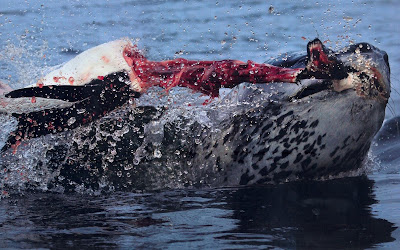
Moral arguments are always the worst, simply because they lack universality. The world is not black and white, and fuck if it's always shaded in gray.

"Good sir, can you show me to that place where sea lions ride the waves to the shore?"
--Ok, one more picture. That's it, I swear.
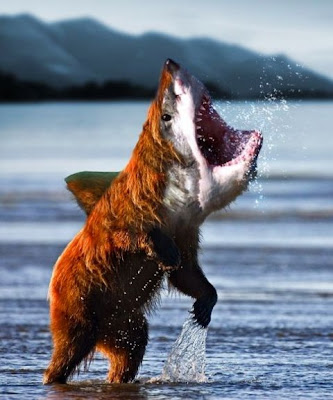
Terrifying.
Anyways, onto the short documentary.
It got Kanye'd. Haha. It happens at the MTV awards, chalk it up to the zany nature. It happens at the academy awards? You betta bet there was some monocle droppage.
I'll try and put this together as fairly as possible. The documentary that won was about a woman in Africa who suffers from natural disfigurement, making her "tainted by witchcraft" amongst locals, that sings in a band, and to a lesser extent her band, who also suffer from deformities. There were originally two people involved in the direction/shooting of this short documentary or whatever, and naturally they had different ideas on what the direction was to be (oh, so that's what a director does). Anyways, one director wanted it to be about the woman, the other wanted it to be about the band. The one who wanted it to be about the woman won, and finished the movie listed as the director, and thus the recipient of the award. The other person, having contributed, managed to keep a role as producer in the credits, though largely maintained a position of disowning the film. The movie wins, and the director walks up and gives a speech. The other person crashes through (apparently to the protest of the director's 90 some year old mother, hah) and runs up, interrupts the speech only a few short words into it, and doesn't let the other dude finish.
So let me rephrase that. The director, who's documentary was his vision, gets cut out of his own acceptance speech by the partner who only the day prior had pretty much disowned any attachment to the project.
At least Beyonce was nominated for an award when the proceedings were interrupted on her behalf; and its probably less emotionally jarring for this to happen to a middle aged man than to an 18 year old girl.
BTW, last time a "major" motion picture, and not an "independent" film won best picture was only a few years ago with The Departed (2006). And possibly one of the "largest" films ever made, Return of the King (2003) has won recently, and blockbusters simply dominated in the late 90s. So, even with an expanded field, the academy can't pick one of its own major studio films to win the best picture award. Wow. I really question a lot here, but I'll leave this as it is.
You guys got enough pictures, no video.
-- Knuttel
I realize that nothing can ever be truly objective, even the simple presentation of facts is always filtered by the mind which organizes them. But does every single modern documentary have to simply go for an emotional response?
OK, so not all the oscar winners and nominees were feel good stories, but the fact remains that they were all emotional. Even the documentary Food Inc., while producing a lot of fact filled moments and tried earnestly to expose wrongful practices of the large food industry, spent many many moments on emotional pieces, which usually didn't add anything major to the story.
In addition to this, The documentary awards (short and long) are often seen as a reflection of issues that hollywood, or the academy, care(s) about.
And so the winner for long documentary was a fluff piece (The Cove) about the Japanese practice of eating dolphins (and whales), and some of their methods of hunting. Sure, I don't personally agree with the eating of these animals, but I also come from a society where this is certainly not the norm, and really isn't accepted either. In Japan, there is a long history and tradition of eating these creatures, much like there is a tradition for them to eat other creatures of the sea. Japan is a series of islands, with alot of coastline, and not alot of land. It makes perfect sense they'd turn to the sea for sustinence. Alas, I digress. Possibly the thing that irks me the most about it is they don't have any regard at all for what Japan thinks of it. A good chunk of the movie was about how the locals were opposed to this film and how difficult it was for this film crew to get this message across to the world. (Good for you, thanks). OK, maybe the methods of hunting they use aren't that "humane", but frankly what is humane hunting anyway. These are probably the same idiots that want the deer population to starve themselves to death rather than get hunted down, cos it's natural -- nevermind that their natural predators haven't been in most of these areas for over 100 years. Goddamnit, I digress again.
Really the makers of this film come off as more ignorant than the people they're trying to portray. Even the title (The Cove) implies this is a secret and dirty act they are doing, and this is the only place this happens, and we, as responsible members of this western world, must be the ones to stop it.
It's like if a film crew went to Mexico to make a documentary about how the people are savages, making tacos instead of hamburgers.
What about Eskimo hunting? Is that OK? They hunt all sorts of sea mammals (which I'm assuming is the criteria for making this evil, being mammal). I can just imagine one of the producers trying to talk to an Inuit -- "Don't you know you can get all your protein sources from Soy and Soy byproducts? Where's your nearest Wholefoods?" "Geeeee, Thaaaaaaanks."
Like I said in my previous post, it's this total lack of self-awareness that makes the academy awards watchable.

Moral arguments are always the worst, simply because they lack universality. The world is not black and white, and fuck if it's always shaded in gray.

"Good sir, can you show me to that place where sea lions ride the waves to the shore?"
--Ok, one more picture. That's it, I swear.

Terrifying.
Anyways, onto the short documentary.
It got Kanye'd. Haha. It happens at the MTV awards, chalk it up to the zany nature. It happens at the academy awards? You betta bet there was some monocle droppage.
I'll try and put this together as fairly as possible. The documentary that won was about a woman in Africa who suffers from natural disfigurement, making her "tainted by witchcraft" amongst locals, that sings in a band, and to a lesser extent her band, who also suffer from deformities. There were originally two people involved in the direction/shooting of this short documentary or whatever, and naturally they had different ideas on what the direction was to be (oh, so that's what a director does). Anyways, one director wanted it to be about the woman, the other wanted it to be about the band. The one who wanted it to be about the woman won, and finished the movie listed as the director, and thus the recipient of the award. The other person, having contributed, managed to keep a role as producer in the credits, though largely maintained a position of disowning the film. The movie wins, and the director walks up and gives a speech. The other person crashes through (apparently to the protest of the director's 90 some year old mother, hah) and runs up, interrupts the speech only a few short words into it, and doesn't let the other dude finish.
So let me rephrase that. The director, who's documentary was his vision, gets cut out of his own acceptance speech by the partner who only the day prior had pretty much disowned any attachment to the project.
At least Beyonce was nominated for an award when the proceedings were interrupted on her behalf; and its probably less emotionally jarring for this to happen to a middle aged man than to an 18 year old girl.
BTW, last time a "major" motion picture, and not an "independent" film won best picture was only a few years ago with The Departed (2006). And possibly one of the "largest" films ever made, Return of the King (2003) has won recently, and blockbusters simply dominated in the late 90s. So, even with an expanded field, the academy can't pick one of its own major studio films to win the best picture award. Wow. I really question a lot here, but I'll leave this as it is.
You guys got enough pictures, no video.
-- Knuttel
3.05.2010
Movement and Music
What is music? Besides a simple collection of notes or sounds or whatever, I think the answer is always personal. It has more to do with how one was introduced to music, how one listened to music, what they were exposed to; a list of likes and dislikes is never really quite simple.
For example: I hate Creed, but damnit if their first album isn't genius. Shit, I even have the two after that, in hopes they could re-catch that somehow. Alas, the singer was a douche.
For me music has always been about movement. I think it started in my middle school years. I had been subjected to painfully long busrides starting in 4th grade, and had a cd player in 5th (that I was subsequently banned from taking to school due to repeating harmless, though explicit, lyrics from a band I haven't listened to since, 311), so 6th grade was when this really started to expand and grow. It was also when I decided to pick up the guitar (fuck you high school and collegiate posers who only know the chords to "wonderwall", oasis sucks anyway). This connection just naturally developed. I was in motion and the music went in motion. The music went in motion as I went in motion. This would happen for hours a day, five days a week, all school year long.
And so naturally I gravitated to music that had a well defined notion of motion. Metal became an obvious choice for my middle school self, though naturally listening to rock radio of the late 90's, Metallica and Sabbath were often supplanted by Ozzy, Smashing Pumpkins, a slew of post-grunge bands, and the one blur album with "that woohoo song".
High School came along and naturally that led to more musical exploration. Again I had a painfully long bus ride, though only the return trip (we had to wait outside a different school for about an hour to pick those kids up). Metal was explored further, though often only nominally. Post-grunge quickly gave way to classic rock. Pink Floyd introduced me to atmospheric music, which is when I learned of my synesthesia. Atmospheric music introduced me to Radiohead. Radiohead introduced me to britpop. I refound my old blur cd(s I actually had 13 also, in anticipation of another "woohoo song") and subsequently found the entire blur catalog, just in time for their next release, Think Tank. In time I went back and searched for music from the original britpop band, The Beatles.
College came and I found jazz, which is nothing but movement. There is always a chord progression or a note progression or a scale progression. Something is always going on. Even in Free Jazz, it's just different kind of movements, movements of colors, shapes, feelings. Thus Jazz is "faster" than any kind metal, thrash, speed or otherwise.
Speaking of metal, this is also when the actual deep diving into the metal world began. What I listened to in middle school was but a wading. Funny thing is even then I knew hair metal sucked.
But all of this music I had listened to, all of it had a sense of motion to it, a sense of time, whether strict or abstract. Good music to me always knew when to move, how fast to move, when to stay still, for how long should it stay still, etc. "Echoes" has long been my favorite Pink Floyd song, because at the bridge, it simply just stops for 10 minutes, exploring its own cavernous space, and echoes itself back into the verse and chorus.
And for the music, a song which actually moves remarkably slow, which suits it much better than one would think.
-- Knuttel
PS. the current singer/songwriter who probably has the best sense of this is Lady GaGa.
For example: I hate Creed, but damnit if their first album isn't genius. Shit, I even have the two after that, in hopes they could re-catch that somehow. Alas, the singer was a douche.
For me music has always been about movement. I think it started in my middle school years. I had been subjected to painfully long busrides starting in 4th grade, and had a cd player in 5th (that I was subsequently banned from taking to school due to repeating harmless, though explicit, lyrics from a band I haven't listened to since, 311), so 6th grade was when this really started to expand and grow. It was also when I decided to pick up the guitar (fuck you high school and collegiate posers who only know the chords to "wonderwall", oasis sucks anyway). This connection just naturally developed. I was in motion and the music went in motion. The music went in motion as I went in motion. This would happen for hours a day, five days a week, all school year long.
And so naturally I gravitated to music that had a well defined notion of motion. Metal became an obvious choice for my middle school self, though naturally listening to rock radio of the late 90's, Metallica and Sabbath were often supplanted by Ozzy, Smashing Pumpkins, a slew of post-grunge bands, and the one blur album with "that woohoo song".
High School came along and naturally that led to more musical exploration. Again I had a painfully long bus ride, though only the return trip (we had to wait outside a different school for about an hour to pick those kids up). Metal was explored further, though often only nominally. Post-grunge quickly gave way to classic rock. Pink Floyd introduced me to atmospheric music, which is when I learned of my synesthesia. Atmospheric music introduced me to Radiohead. Radiohead introduced me to britpop. I refound my old blur cd(s I actually had 13 also, in anticipation of another "woohoo song") and subsequently found the entire blur catalog, just in time for their next release, Think Tank. In time I went back and searched for music from the original britpop band, The Beatles.
College came and I found jazz, which is nothing but movement. There is always a chord progression or a note progression or a scale progression. Something is always going on. Even in Free Jazz, it's just different kind of movements, movements of colors, shapes, feelings. Thus Jazz is "faster" than any kind metal, thrash, speed or otherwise.
Speaking of metal, this is also when the actual deep diving into the metal world began. What I listened to in middle school was but a wading. Funny thing is even then I knew hair metal sucked.
But all of this music I had listened to, all of it had a sense of motion to it, a sense of time, whether strict or abstract. Good music to me always knew when to move, how fast to move, when to stay still, for how long should it stay still, etc. "Echoes" has long been my favorite Pink Floyd song, because at the bridge, it simply just stops for 10 minutes, exploring its own cavernous space, and echoes itself back into the verse and chorus.
And for the music, a song which actually moves remarkably slow, which suits it much better than one would think.
-- Knuttel
PS. the current singer/songwriter who probably has the best sense of this is Lady GaGa.
2.11.2010
Article
Psychologists are trying to take over the country.
I might put up a rant about this later, but I'm kinda tired and angry. damn blizzard.
http://www.washingtonpost.com/wp-dyn/content/article/2010/02/10/AR2010021000009.html?wpisrc=nl_headline
-- Knuttel
I might put up a rant about this later, but I'm kinda tired and angry. damn blizzard.
http://www.washingtonpost.com/wp-dyn/content/article/2010/02/10/AR2010021000009.html?wpisrc=nl_headline
-- Knuttel
1.24.2010
And where the fuck were you?!?!
I love playing with the emphasis on that. I think the closeness of where to were really helps with it.
Anyways, I obviously have been away from this for a while. I'm contemplating maybe some format changes, cos let's be honest, no one reads this anyway.
In any case, there will be something "real" up likely tomorrow, maybe on Haiti, maybe on more pressing matters, like the Lifetime movie Cyber Seduction. Whatever the case may be, prepare to be enthralled.
So lately I've been organizing my efforts to be an even more super awesome person on my road to personal betterment. A few nights ago, after "Jersey Shore" came to a close, I popped in my old smashing pumpkins dvd (Vieuphoria, if anyone's wondering), and as I'm watching Billy Corgan straight up wail out song after song, I realize something -- I used to be able to play like that, and what the fuck happenned. Ok, maybe not that good. But the point stands. I used to have well above average chops and a fuggin awesome ear, and due mostly to "guitar atrophy", I've lost ability in both, though mostly the former.
That being said, I have not-so-carefully crafted a list of songs from four artists, three of which had a pretty profound influence on my "playing days". It could get expanded or amended in the future, but goddamnit, I am going to learn these songs; every single one. Let's see how far i get/bad it gets before I make any changes.
so the list, broken down by album (from american release) + 1 single
Smashing Pumpkins
Gish
Siva
Rhinoceros
I am one
Crush
Siamese Dream
Geek USA
Cherub Rock
Soma
Hummer
Quiet
Mellon Collie and the Infinite Sadness
Zero
Muzzle
Where the Boys feared to tread
Bodies
Jellybelly
An ode to no one
Xyu
Thru the eyes of ruby
Porceleina of the oceans
1979
Here is no why
To forgive
Bullet with butterfly wings
Love
Tales of a scorched earth
Blur
Modern life is rubbish
Popscene
Parklife
This is a low
London loves
Blur
Beetlebum
m.o.r
on your own
you’re so great
movin on
13
Bugman
Coffee and tv
Radiohead
Pablo Honey
Blow out
The bends
Street spirit
Sulk
Planet telex
Black star
My Iron lung ep
The trickster
Permanent daylight
Ok computer
Airbag
Paranoid android
Lucky
(single)
talk show host
Kid a
Morning bell
Everything in its right place
National anthem
Amnesiac
Knives out
I might be wrong
Dollars and cents
Hail to the thief
2+2=5
Backdrifts
Go to sleep
There, there
Where I end and you begin
Mastodon
Leviathan
Seabeast
Blood and thunder
Iron tusk
Blood mountain
Colony of birchmen
Hunters of the sky
This mortal soil
Sleeping giant
Crack the skye
Oblivion
Those last ones are gonna be a doozy, damn hybrid picking.
and now, because it would be unfair to pick one video after listing a bunch of awesome music, an equally awesome link.
Jersey Shore Nickname Generator
Could You be the next "the situation" or "ms./mrs the situation"?
Maybe you'll find out what a snooki is....
-- Knuttel
Anyways, I obviously have been away from this for a while. I'm contemplating maybe some format changes, cos let's be honest, no one reads this anyway.
In any case, there will be something "real" up likely tomorrow, maybe on Haiti, maybe on more pressing matters, like the Lifetime movie Cyber Seduction. Whatever the case may be, prepare to be enthralled.
So lately I've been organizing my efforts to be an even more super awesome person on my road to personal betterment. A few nights ago, after "Jersey Shore" came to a close, I popped in my old smashing pumpkins dvd (Vieuphoria, if anyone's wondering), and as I'm watching Billy Corgan straight up wail out song after song, I realize something -- I used to be able to play like that, and what the fuck happenned. Ok, maybe not that good. But the point stands. I used to have well above average chops and a fuggin awesome ear, and due mostly to "guitar atrophy", I've lost ability in both, though mostly the former.
That being said, I have not-so-carefully crafted a list of songs from four artists, three of which had a pretty profound influence on my "playing days". It could get expanded or amended in the future, but goddamnit, I am going to learn these songs; every single one. Let's see how far i get/bad it gets before I make any changes.
so the list, broken down by album (from american release) + 1 single
Smashing Pumpkins
Gish
Siva
Rhinoceros
I am one
Crush
Siamese Dream
Geek USA
Cherub Rock
Soma
Hummer
Quiet
Mellon Collie and the Infinite Sadness
Zero
Muzzle
Where the Boys feared to tread
Bodies
Jellybelly
An ode to no one
Xyu
Thru the eyes of ruby
Porceleina of the oceans
1979
Here is no why
To forgive
Bullet with butterfly wings
Love
Tales of a scorched earth
Blur
Modern life is rubbish
Popscene
Parklife
This is a low
London loves
Blur
Beetlebum
m.o.r
on your own
you’re so great
movin on
13
Bugman
Coffee and tv
Radiohead
Pablo Honey
Blow out
The bends
Street spirit
Sulk
Planet telex
Black star
My Iron lung ep
The trickster
Permanent daylight
Ok computer
Airbag
Paranoid android
Lucky
(single)
talk show host
Kid a
Morning bell
Everything in its right place
National anthem
Amnesiac
Knives out
I might be wrong
Dollars and cents
Hail to the thief
2+2=5
Backdrifts
Go to sleep
There, there
Where I end and you begin
Mastodon
Leviathan
Seabeast
Blood and thunder
Iron tusk
Blood mountain
Colony of birchmen
Hunters of the sky
This mortal soil
Sleeping giant
Crack the skye
Oblivion
Those last ones are gonna be a doozy, damn hybrid picking.
and now, because it would be unfair to pick one video after listing a bunch of awesome music, an equally awesome link.
Jersey Shore Nickname Generator
Could You be the next "the situation" or "ms./mrs the situation"?
Maybe you'll find out what a snooki is....
-- Knuttel
1.21.2010
a snack
http://sports.espn.go.com/espn/columns/story?columnist=ohlmeyer_don&id=4844048
a little insight on the leach firing. ill probably put something real of mine up later.
a little insight on the leach firing. ill probably put something real of mine up later.
11.29.2009
Knuttel poetry break
So for some incredibly inexplicable reason I decided to pick poetry back up. I know, I know, poetry goes on the other blog, but whatevs, that one's obsolete, forever tied to an obsolete email address (my psu account).
I never really was a fan of editing poetry, so here's the night's first attempt.
working title -- wrapped and bound (it really, really is a working title)
Upon the streets
I walk
Into the darkness
Until we meet
I sulk
Inside this sweetness
And when the day comes, forever madness
Fates have been judged by all we haven’t done
The setting sun
It sinks
Into its ashes
The rising moon
Shall glow
Inside the hollow
The hollow of the hallowed night is right
It burns inside our empty chambers now
We cannot be filled
We cannot be filled
The heavy are slow
The full cannot move
-- Knuttel
and for some real amusement, space cowboy
soon should be a post on the current state of college football
I never really was a fan of editing poetry, so here's the night's first attempt.
working title -- wrapped and bound (it really, really is a working title)
Upon the streets
I walk
Into the darkness
Until we meet
I sulk
Inside this sweetness
And when the day comes, forever madness
Fates have been judged by all we haven’t done
The setting sun
It sinks
Into its ashes
The rising moon
Shall glow
Inside the hollow
The hollow of the hallowed night is right
It burns inside our empty chambers now
We cannot be filled
We cannot be filled
The heavy are slow
The full cannot move
-- Knuttel
and for some real amusement, space cowboy
soon should be a post on the current state of college football
5.30.2009
A second look at that Wolverine movie thing
Due to the subject matter of the movie being so pressing for the world of comic books, I have decided to take a second look at X-Men Origins: Wolverine (though it's probably more like x-men oranges:tangerine, amirite?), this time observing the final, completed project.
I feel I should explain how this viewing came to be. Well, it was Wednesday, and some friends and I were watching the UEFA Champions league game in Center City in a bar, and being drunk and suggestible, we decided it was a good idea to watch that wolverine movie, i think as a joke, but does it really matter at this point?
First things first
What was different from the leak to the finished product? If you recall, the leak came out a month ahead of the planned theater release, the special effects look unfinished all around, and they claimed they had to add a scene or two.
Well, the scenes that looked really unfinished (as in stand in computer graphics) were finished, but that was pretty much it. Aside from the final fight with "deadpool", there was little to none done to improve the special effects of the movie. In fact, I waited through the credits to see that final clip that was rumored (meh). The real joy from doing this was seeing how short the actual credits were. For a movie of that production value scale, it was extremely small in fact -- compare to waiting till the end of one of the Matrixes (probably reloaded) to see that clip, the credit list was monstrous. It's as if they simply plan on passing out x:men movies as quick as possible, knowing that they're a sellable commodity, even when they suck (see: X3).
Oh, and the "younger" Professor X looks like a clown. And, little nit picking note here, but didn't Prof X lose his ability to walk sometime in the 50's or 60's (not sure of the exact date/year, but Lucifer dropped a rock on his legs or something before he founded the X men). The bulk of the wolverine movie appears to take place in the 70's -- that's another thing, for something that needs to rely so strongly on convention and proven methods of writing workable "dramatic" matierial, the action is spread out over a veeerrrryyy long period of time, and that's not even counting the "throwaway" intro showing what Wolvie and Sabretooth did from the mid 1800's (before Canada, let alone the NW territories existed) until they got kicked out the the AMERICAN army during Vietnam.
The worst part may actually still be the deadpool treatment. It appears as if somehow during the course of that month when the movie was leaked and outrage stormed, one of the gaff boys or whatever was actually decided to pick up a (and i mean a, singular) deadpool comic and tried coaxing the director to throw some shit in there. The result was really only two things -- his face is scarred (though not that much, and not because of cancer) and at one point the area around his eyes was black, like his mask (except this was on his skin, as a reaction to shooting cyclops' optic blasts). I wouldn't be surprised to go back and look at the credits and see T-Ray as a producer.
I'm still puzzeled as to how they could have screwed it up that much. Really. The humor was there though, in a mystery science theater 3000 sort of way. Still no consolation.
I feel I should explain how this viewing came to be. Well, it was Wednesday, and some friends and I were watching the UEFA Champions league game in Center City in a bar, and being drunk and suggestible, we decided it was a good idea to watch that wolverine movie, i think as a joke, but does it really matter at this point?
First things first
What was different from the leak to the finished product? If you recall, the leak came out a month ahead of the planned theater release, the special effects look unfinished all around, and they claimed they had to add a scene or two.
Well, the scenes that looked really unfinished (as in stand in computer graphics) were finished, but that was pretty much it. Aside from the final fight with "deadpool", there was little to none done to improve the special effects of the movie. In fact, I waited through the credits to see that final clip that was rumored (meh). The real joy from doing this was seeing how short the actual credits were. For a movie of that production value scale, it was extremely small in fact -- compare to waiting till the end of one of the Matrixes (probably reloaded) to see that clip, the credit list was monstrous. It's as if they simply plan on passing out x:men movies as quick as possible, knowing that they're a sellable commodity, even when they suck (see: X3).
Oh, and the "younger" Professor X looks like a clown. And, little nit picking note here, but didn't Prof X lose his ability to walk sometime in the 50's or 60's (not sure of the exact date/year, but Lucifer dropped a rock on his legs or something before he founded the X men). The bulk of the wolverine movie appears to take place in the 70's -- that's another thing, for something that needs to rely so strongly on convention and proven methods of writing workable "dramatic" matierial, the action is spread out over a veeerrrryyy long period of time, and that's not even counting the "throwaway" intro showing what Wolvie and Sabretooth did from the mid 1800's (before Canada, let alone the NW territories existed) until they got kicked out the the AMERICAN army during Vietnam.
The worst part may actually still be the deadpool treatment. It appears as if somehow during the course of that month when the movie was leaked and outrage stormed, one of the gaff boys or whatever was actually decided to pick up a (and i mean a, singular) deadpool comic and tried coaxing the director to throw some shit in there. The result was really only two things -- his face is scarred (though not that much, and not because of cancer) and at one point the area around his eyes was black, like his mask (except this was on his skin, as a reaction to shooting cyclops' optic blasts). I wouldn't be surprised to go back and look at the credits and see T-Ray as a producer.
I'm still puzzeled as to how they could have screwed it up that much. Really. The humor was there though, in a mystery science theater 3000 sort of way. Still no consolation.
4.07.2009
The suck fest that is "X Men Origins: Wolverine"

Now, before I begin, I want to make it clear that Fox said it was OK to download this movie off the internet. Therefore, this review is not illegal.
I also want to mention, before I begin, that I will not comment at all on any of the special effects, or any bit of the movie where quality would in itself be depreciated by the lack of the finished special effects.
X Men Origins: Wolverine may be the worst comic book movie ever made, ever. This includes Nick Fury, Agent of S.H.I.E.L.D starring Davind Hasselhoff, the practically unlicensed Fantastic Four from the mid 90s, Daredevil, Spiderman 3, and of course, X3 X Men United.
The reasons themselves are legion. The character of Wolverine was of the utmost importance to me as a child, so this offense is personal. It also gives me a certain kind of insight as to where abouts they went wrong. The characters of Deadpool and Gambit are also important to me, especially recently Deadpool. I also know very in depth the stories of Alpha Flight and Weapon X (also team x), which form the basis of any Wolverine origin story.
1. They never mention Alpha Flight by name, and it appears to be American in origin, as opposed to Canadian, despite having four Canadian members (Wolvie, Sabretooth, Deadpool, and John Wraith).
2. The X in weapon X is given as a number in a series of Weapons. This follows in the NEVER TO BE FOLLOWED Grant Morrison New X-Men story, which ties it to Captain America (Weapon I) etc. Would be nice, except this definitely does not seem like a tie into the Avengers Universe of Iron Man and The Incredible Hulk, making the point entirely moot.
3. Deadpool is gone within a matter of minutes.
4. Many members of Alpha Flight that shouldn't be in the group -- Bolt, Blob.
5. Deadpool doesn't have any powers at all in the beginning except being badass at martial arts. Also he has a distaste for using anything besides his swords, which is a lie because he will use anything at his disposal, including guns.
6. Sabretooths claws extend. WTF
7. Silver Fox is only loosely attached to weapon x, and has the power of persuasion. Oh, and she's related to Emma Frost (White Queen).
8.Blob is not extremely obese to start.
9. John Wraith teleports at will in public, in fact showboating it. In reality, he wants no one at all to know that he can teleport, even hides his powers from his teammates.
10. Really, I'm getting tired of naming every single innacuracy, and I kinda feel bad about nitpicking like this. Why don't I move straight to who is to blame. The list is long
1. Rupert Murdoch, head of Fox. Let this movie be made.
2. Marvel. Sold the rights to X Men pretty much entirely since X3. This is a Fox movie using Marvel characters, as opposed to being a Marvel movie produced by Fox.
3. Fox, they really screwed up the story of arguably one of the most followed Comic book characters of the past 25 years. Even people who did not follow comics followed Wolvie.
4. Grant Morrison. His New X Men storyline about Weapon X is the one predominantly used. It also happens to be the one that is never ever used in any other X Men continuity.
5. Ryan Reynolds. He played an adequately well enough Deadpool that they had to identify not only the character in the beginning as Wade Wilson, but the monstrosity at the end (see picture above) as Deadpool. We all know that is not Deadpool by any stretch.
6. Hugh Jackman. He's really digging this whole Wolvie gig, except he sucks at it. Kinda funny how the voice of Wolverine in the short lived show Pride of the X Men was Australian. Just a funny coincidence is all. He also thinks he's the current foremost expert on the character. It's a shame really, cos it seems he doesn't know a thing.
7. David Beinoff. He's the man who wrote this piece of garbage. Probably never picked up a comic book in his life (ahem Tim Burton's Batman ahem).
8. The World Series of Poker. Gambit's entrance is at an underground high stakes poker game. Not exactly where I'd picture him. Oh, they're probably also playing Texas Hold 'em, not the poker game I'd picture him playing. Oh, and there's cameos by some people who do that world series thing or whatever its called.
9. Gavin Hood. He directs this piece of crap.
10. Whoever thought it was a good idea to do what they did to Deadpool. Deadpool was part of Weapon X, he got the healing factor to cure his cancer, and then became crazy, the merc with the mouth. He did not receive about 20 different powers to become some sort of controllable monster that cannot speak.
Seriously, what they did to Deadpool was unforgivable. I am going to have to write an alternate movie solely for Deadpool. I'm thinking something along the lines of a Jay and Silent Bob Strike Back type of deal, maybe, except instead of dodging Will Ferrel, it's like Taskmaster or T-Ray or something.
And why does he never break the fourth wall? That can be very easily done. Just have him fuggin narrate the thing in real time, seen on screen. Really, not that hard.
How could they screw something like this up that badly? I feel like a part of my childhood has been cornered in a dark alley and raped repeatedly.
-- Knuttel
3.22.2009
Season 8, what hath become of you? (update)
Season 8 (Degrassi), from the start, was going to be an interesting experience. None of the students attending the school in season 1 attend the school anymore. Spinner still hangs around, even though he graduated, and Snake still teaches there. Emma, Manny, and Liberty are all out on their college experience.
But something grave has happened.
The man has found Degrassi.
It may have popped up as an anomaly where The Principal or the Cops or some other force has been the ultimate and true law, overruling everything about kid law. Season 8 thus far has been an exception. While the Principal himself as giver of the law may have been subverted to a certain extent (though after his totalitarian management of the football team), the kids have all been subject to laws outside of their own realm.
This has become really strong as of late. It began with "Heat of the Moment." The main plotline deals with a little sort of squabble that ends up online, where Alli makes a fool of Holly J to the extent that she doesn't want to come into school. This in and of itself would not be so bad, except, inexplicably, Acting Principal Snake Simpson and the Toronto Police Department both found out about this, giving her a school suspension, a juvenile criminal record, and at least a months worth of punishment from the parents.
It is a serious issue, for sure, but by some deus ex machina, Alli managed to get the worst punishment she could really get for this, and it all came seemingly from the outside. Not even Holly J was the one pressing charges. When Degrassi last dealt with bullying in general (not on the interwebs) the student himself eventually took matters into his own hands and shot the dude. Now, I'm not advocating School shootings by any stretch of the imagination, but this is a drastic shift in tone for the show. Before the adults were callous, uncaring, disinterested, and never out for the best interests. Now all of a sudden, they are watching, they will act when something is done wrong, and they claim (indisputably) that they are the best interest. When did Degrassi turn into Narc High?
3 episodes later, Narc-ville returns, in "Touch of Grey," which has only so far aired in Canada (thank you interwebs). In this episode, the main plotline deals with Emma's struggle to find an identity at college, in the process her nickname changes from "Blonde Emma" (even though at this point she is a brunette) to "Blaze." Yeah, this episode deals with pot, and what I assume to be outdated slang (I'm giving the kids younger than me some credit, surely they must use at least slightly different terminology). In this episode, a new friend of Emma's enters into a diabetic coma, and I am not making this up, because she forgets that she has diabetes after getting high off a few pot brownies. The RA's immediately know the culprit was pot brownies, because the method of choice for getting high by diabetics is naturally to consume pot with an extremely sugary baked confection. Campus police eventually catch up to "Blaze"'s roommate/boyfriend, who is trying to ditch her stash, because she didn't think of doing it herself earlier.
Compare this wth the way pot was dealt with during season 7 (before hand it was simply alluded to). Two instances specifically come up, one in "Love is Like a Battlefield" the other in the aptly titled "Pass the Ductchie." Both of these have very real circumstances, none of which are too heavyhanded. Both of which are ambiguous. In the first, Alex smokes up with Jay as a way to cheer him up after he gets dumped. Their friendship goes way back, and Jay had been alluded to as a smoker previously. This costs Alex her ability to help out her girlfriend, Paige, with her newfound job, and thus eventually costs her the relationship. In the latter, Spinner is dealing with chemotherapy and is having difficulty holding things down. Jay suggests to him that marijuana may help him with this (naturally Jay knows of its anti-emitic properties). It helps Spinner hold both his medicine and his food down, and everything is fine and dandy, until he loses focus in school (a recurring problem with him, mind you) and has some minor fights with his girlfriend, mainly about hanging out too much with his ex. He decides to stop, deal with the constant vomiting of chemo, and focus on school. What a trooper.
Both of these instances dealt with the actual effects of marijuana on the user, and not the possession of said substance. In addition, neither of those instances paints a black and white picture of marijuana use, and have arguably deleterious effects if they had chosen not to partake. If Alex hadn't smoked up with Jay, it would have soured that moment in their friendship, Alex disavailing herself while Jay needs her the most. If Spinner hadn't smoked up, he would have been throwing up even more. It gave him a few days of holding everything down, and he eventually learns on his own that he'd rather go without it. Jay isn't even painted as a stereotypical pothead. Thuggish, sure, pothead, nah, not really. Compared to Kelly's friend, total pothead (even down to recreational frisbee).
So why shift gears like this? It seems in the Degrassi universe, no longer is it the consequences of your own actions on your friends which affects you. No, it is the consequences from outside authority figures on seeing your actions that affects you.
Is Canada entering into some sort of Police State I am unaware of?
-- Knuttel
The intermediary episode (a two parter, "Jane Says") actually dealt with an important issue, the first time in a while they've dealt with such a serious issue. Sadly the secondary plots in both just seemed annoying. 1) don't lie to the popular kids because they are petty, and have poor taste in tv and music; 2) Claire starts attracting male attention away from Alli. Way to counterbalance child molestation. Yeah, and they definitely did scale back on the issue itself in both of them, old degrassi would have been much more intense.
And while I'm at it, what is the deal with all of the retconning?
Edit: An episode in Season 5 deals with pot, "Death of a Disco Dancer" I believe is what it was called. Paige gets a joint from her former Teacher/boyfriend now exile Matt O upon the official ending of their relationship. After stupidly flailing it about the front steps of the school, Paige and Alex settle on smoking up before the College/Career fair visits. Paige eventually has to interview with the representative from Banting (like the Ivy equivalent) who is also a family friend. She freaks out, her mom finds out she smoked, an she gets grounded or whatever. But again, here it is not the possession of Marijuana which caused the problem, and it's not the all seeing eye which incurred wrath. Again too, the situation surrounding the consumption is rather ambiguous. While Palex is certainly not making out, it is certainly in its beginning stages, and doing this helped to strengthen the budding friendship/romance.
Later in the season, there was another drug related matter. Not only did it deal with a much "harder" drug (percs), but the kid (JT) was straight up dealing them. Again, all of his consequences came from his peers (including his pregnant girlfriend) discovering his dealing and his eventual consumption (and overdose) on the drug itself. It was an ultimate lesson in responsibility, not a childish lesson in -- hey, why do you have that, you're not supposed to have that, I'm telling, you're gonna get in soo much trouble.
After all of these years, does Degrassi have to grow up?
But something grave has happened.
The man has found Degrassi.
It may have popped up as an anomaly where The Principal or the Cops or some other force has been the ultimate and true law, overruling everything about kid law. Season 8 thus far has been an exception. While the Principal himself as giver of the law may have been subverted to a certain extent (though after his totalitarian management of the football team), the kids have all been subject to laws outside of their own realm.
This has become really strong as of late. It began with "Heat of the Moment." The main plotline deals with a little sort of squabble that ends up online, where Alli makes a fool of Holly J to the extent that she doesn't want to come into school. This in and of itself would not be so bad, except, inexplicably, Acting Principal Snake Simpson and the Toronto Police Department both found out about this, giving her a school suspension, a juvenile criminal record, and at least a months worth of punishment from the parents.
It is a serious issue, for sure, but by some deus ex machina, Alli managed to get the worst punishment she could really get for this, and it all came seemingly from the outside. Not even Holly J was the one pressing charges. When Degrassi last dealt with bullying in general (not on the interwebs) the student himself eventually took matters into his own hands and shot the dude. Now, I'm not advocating School shootings by any stretch of the imagination, but this is a drastic shift in tone for the show. Before the adults were callous, uncaring, disinterested, and never out for the best interests. Now all of a sudden, they are watching, they will act when something is done wrong, and they claim (indisputably) that they are the best interest. When did Degrassi turn into Narc High?
3 episodes later, Narc-ville returns, in "Touch of Grey," which has only so far aired in Canada (thank you interwebs). In this episode, the main plotline deals with Emma's struggle to find an identity at college, in the process her nickname changes from "Blonde Emma" (even though at this point she is a brunette) to "Blaze." Yeah, this episode deals with pot, and what I assume to be outdated slang (I'm giving the kids younger than me some credit, surely they must use at least slightly different terminology). In this episode, a new friend of Emma's enters into a diabetic coma, and I am not making this up, because she forgets that she has diabetes after getting high off a few pot brownies. The RA's immediately know the culprit was pot brownies, because the method of choice for getting high by diabetics is naturally to consume pot with an extremely sugary baked confection. Campus police eventually catch up to "Blaze"'s roommate/boyfriend, who is trying to ditch her stash, because she didn't think of doing it herself earlier.
Compare this wth the way pot was dealt with during season 7 (before hand it was simply alluded to). Two instances specifically come up, one in "Love is Like a Battlefield" the other in the aptly titled "Pass the Ductchie." Both of these have very real circumstances, none of which are too heavyhanded. Both of which are ambiguous. In the first, Alex smokes up with Jay as a way to cheer him up after he gets dumped. Their friendship goes way back, and Jay had been alluded to as a smoker previously. This costs Alex her ability to help out her girlfriend, Paige, with her newfound job, and thus eventually costs her the relationship. In the latter, Spinner is dealing with chemotherapy and is having difficulty holding things down. Jay suggests to him that marijuana may help him with this (naturally Jay knows of its anti-emitic properties). It helps Spinner hold both his medicine and his food down, and everything is fine and dandy, until he loses focus in school (a recurring problem with him, mind you) and has some minor fights with his girlfriend, mainly about hanging out too much with his ex. He decides to stop, deal with the constant vomiting of chemo, and focus on school. What a trooper.
Both of these instances dealt with the actual effects of marijuana on the user, and not the possession of said substance. In addition, neither of those instances paints a black and white picture of marijuana use, and have arguably deleterious effects if they had chosen not to partake. If Alex hadn't smoked up with Jay, it would have soured that moment in their friendship, Alex disavailing herself while Jay needs her the most. If Spinner hadn't smoked up, he would have been throwing up even more. It gave him a few days of holding everything down, and he eventually learns on his own that he'd rather go without it. Jay isn't even painted as a stereotypical pothead. Thuggish, sure, pothead, nah, not really. Compared to Kelly's friend, total pothead (even down to recreational frisbee).
So why shift gears like this? It seems in the Degrassi universe, no longer is it the consequences of your own actions on your friends which affects you. No, it is the consequences from outside authority figures on seeing your actions that affects you.
Is Canada entering into some sort of Police State I am unaware of?
-- Knuttel
The intermediary episode (a two parter, "Jane Says") actually dealt with an important issue, the first time in a while they've dealt with such a serious issue. Sadly the secondary plots in both just seemed annoying. 1) don't lie to the popular kids because they are petty, and have poor taste in tv and music; 2) Claire starts attracting male attention away from Alli. Way to counterbalance child molestation. Yeah, and they definitely did scale back on the issue itself in both of them, old degrassi would have been much more intense.
And while I'm at it, what is the deal with all of the retconning?
Edit: An episode in Season 5 deals with pot, "Death of a Disco Dancer" I believe is what it was called. Paige gets a joint from her former Teacher/boyfriend now exile Matt O upon the official ending of their relationship. After stupidly flailing it about the front steps of the school, Paige and Alex settle on smoking up before the College/Career fair visits. Paige eventually has to interview with the representative from Banting (like the Ivy equivalent) who is also a family friend. She freaks out, her mom finds out she smoked, an she gets grounded or whatever. But again, here it is not the possession of Marijuana which caused the problem, and it's not the all seeing eye which incurred wrath. Again too, the situation surrounding the consumption is rather ambiguous. While Palex is certainly not making out, it is certainly in its beginning stages, and doing this helped to strengthen the budding friendship/romance.
Later in the season, there was another drug related matter. Not only did it deal with a much "harder" drug (percs), but the kid (JT) was straight up dealing them. Again, all of his consequences came from his peers (including his pregnant girlfriend) discovering his dealing and his eventual consumption (and overdose) on the drug itself. It was an ultimate lesson in responsibility, not a childish lesson in -- hey, why do you have that, you're not supposed to have that, I'm telling, you're gonna get in soo much trouble.
After all of these years, does Degrassi have to grow up?
3.08.2009
A Watchmen review?
Is this going to be a Watchmen review? To be honest, I don't know and I can't really predict.
Maybe it's just going to be a Snyder (the director) review.
Yes, that is what it is going to be.
The Watchmen was everything 300 was not.
I say this as a man who has read both of these books before seeing the movies. Oh, and yes, they are books; just because they have pictures does not mean they cannot also be literature.
300, Snyder's first film which was not a remake (unless you consider it to be a remake of The 300 Spartans, the movie which probably inspired Miller to write the book) was a faithful adaptation, almost frame for frame. Really, there were several shots, slowed down to emphasize, which were from the book -- something done to great effect most notably in Sin City, but also done to far lesser extents (simple recognizable poses or phrases) in pretty much every comic book movie. But what Snyder cut out was the character development. The redemption of Stelios (or should I say, Stumblios) was cut out entirely, though he was still picked to lead the final charge. The rise of Leonidas himself was too bastardized. Though it was not cut, the scene in which he faces a wolf as a child turned from a coming of age survival story to simple badassery. Also, there was a plotline added where Leonidas' wife tries winning support in Sparta and in the Spartan senate.
The Watchmen, on the other hand sacrificed little, if any, character development. Rorschac's real identity is only alluded to, even when his face is exposed. That was a major flaw, but it doesn't really affect him as a character, it simply helps the audience understand him a little bit better. The curse of the black pearl, the meta-comic, was cut out, but it will be released separately, presumptively straight to video. Again, something that in and of itself does not hurt the media, but helps the audience to better understand what is going on. While both the book and the movie used an ensemble cast, the focus seemed to shift more to Silk Spectre II (or maybe Ackerman was just a scene-stealer). I dunno, maybe I was just drawn more to Rorschac's character when I read it, and the movie obviously couldn't have all of his insanity. They also cut out alot of the story about the Minutemen, the superhero group preceding the Watchmen, also including the Comedian.
Where the "freeze-frames" or slo-mo shots helped with 300, they hurt with Watchmen. 300 was set in a fantacized version of ancient greece. Slowing frames down emphasized their un-realness while making it all seem that much more epic. Watchmen had a realistic, dirty tinge to it. The only superhero with actual superhero powers was Dr. Manhattan, and that happenned in a ridiculously freak accident. These freeze-frames de-realized whatever scenes whenever they happenned.
In the end, as Moore himself said, it was written to sho what comics could do that cinema could not (sic). The universe that was so meticulously created in the comic was faithfully recreated in the movie sets, however movies move too fast. A true adaptation of the book would probably take 4, maybe 5 hours, and wouldn't really be that watchable. This was probably the best a Watchmen adaptation could be. It really is a good attempt, but it is not the best comic book movie, and never really could be unless it was severely stripped down from or "done in the spirit of" the book. Simple as that.
It's been common knowledge that Short Stories usually adapt much better than Novels into movies, now I guess we found out what happens when one full legnth comic with novel-esque depth (300 isn't very long, and Sin City is like an anthology of stories, not all of which were movie-ized (yet)) is adapted into a movie, at 2 hours and 40 minutes, still feeling a little light.
-- Knuttel
Maybe it's just going to be a Snyder (the director) review.
Yes, that is what it is going to be.
The Watchmen was everything 300 was not.
I say this as a man who has read both of these books before seeing the movies. Oh, and yes, they are books; just because they have pictures does not mean they cannot also be literature.
300, Snyder's first film which was not a remake (unless you consider it to be a remake of The 300 Spartans, the movie which probably inspired Miller to write the book) was a faithful adaptation, almost frame for frame. Really, there were several shots, slowed down to emphasize, which were from the book -- something done to great effect most notably in Sin City, but also done to far lesser extents (simple recognizable poses or phrases) in pretty much every comic book movie. But what Snyder cut out was the character development. The redemption of Stelios (or should I say, Stumblios) was cut out entirely, though he was still picked to lead the final charge. The rise of Leonidas himself was too bastardized. Though it was not cut, the scene in which he faces a wolf as a child turned from a coming of age survival story to simple badassery. Also, there was a plotline added where Leonidas' wife tries winning support in Sparta and in the Spartan senate.
The Watchmen, on the other hand sacrificed little, if any, character development. Rorschac's real identity is only alluded to, even when his face is exposed. That was a major flaw, but it doesn't really affect him as a character, it simply helps the audience understand him a little bit better. The curse of the black pearl, the meta-comic, was cut out, but it will be released separately, presumptively straight to video. Again, something that in and of itself does not hurt the media, but helps the audience to better understand what is going on. While both the book and the movie used an ensemble cast, the focus seemed to shift more to Silk Spectre II (or maybe Ackerman was just a scene-stealer). I dunno, maybe I was just drawn more to Rorschac's character when I read it, and the movie obviously couldn't have all of his insanity. They also cut out alot of the story about the Minutemen, the superhero group preceding the Watchmen, also including the Comedian.
Where the "freeze-frames" or slo-mo shots helped with 300, they hurt with Watchmen. 300 was set in a fantacized version of ancient greece. Slowing frames down emphasized their un-realness while making it all seem that much more epic. Watchmen had a realistic, dirty tinge to it. The only superhero with actual superhero powers was Dr. Manhattan, and that happenned in a ridiculously freak accident. These freeze-frames de-realized whatever scenes whenever they happenned.
In the end, as Moore himself said, it was written to sho what comics could do that cinema could not (sic). The universe that was so meticulously created in the comic was faithfully recreated in the movie sets, however movies move too fast. A true adaptation of the book would probably take 4, maybe 5 hours, and wouldn't really be that watchable. This was probably the best a Watchmen adaptation could be. It really is a good attempt, but it is not the best comic book movie, and never really could be unless it was severely stripped down from or "done in the spirit of" the book. Simple as that.
It's been common knowledge that Short Stories usually adapt much better than Novels into movies, now I guess we found out what happens when one full legnth comic with novel-esque depth (300 isn't very long, and Sin City is like an anthology of stories, not all of which were movie-ized (yet)) is adapted into a movie, at 2 hours and 40 minutes, still feeling a little light.
-- Knuttel
2.24.2009
On the Oscars
Let's just get down to the nitty gritty about the Oscars, why not?
Good
-Slumdog Millionaire came up huge. While some in India claim the plot etc is too cliche, it isn't really in America or the West, as the style is one that is predominant mainly in India. I have a feeling they would love Transporter 3, but alas, here it is same old same old.
Bad
-Nomination introductions for the acting awards. What is up with that? It is supposed to be the person of the opposite gender presents the award the next year. For example, if Heath Ledger were alive, he would present best supporting actress next year. Instead they did this huge elaborate ceremony with five past winners talking about awards and whatever, one for each person. When it came down to it, the only two I was really interested in hearing were Chris Walken for Supporting Actor (from Deer Hunter) and Ben Kingsley for Lead Actor (from Ghandi). Also, why wasn't Ben Kingsley nominated for anything? he was in like 6 movies (cancel out another because of the Love guru, so it's 4).
Bad
-Not only did Sean Penn win best actor, but (of course) he used the opportunity to grandstand on the issue of gay rights. I think he also called Obama gay ("I'm glad we have an elegant man as President"????). I should mention I am not against gay rights, it's just he phrased his whole argument alot like Clooney phrased his argument about the freedom of the press when he won for that forgettable anti-McCarthy movie. I wanted to punch Clooney in the face, and I've never liked Sen. McCarthy. While I would be happy if this man died, his life would forever be eulogized in an Eddie Vedder song, and he would be remembered as a martyr. He's always played an asshole, and that's what he is in real life. -- But what about Spacoli? Spacoli was an asshole, didn't anyone actually watch that movie? The only reason Mr. Hand liked him was 'cos he was an asshole too. Not to mention the Academy passed up an opportunity to give a career award to Frank Langella for a legitamately award worthy performance (so I've heard), likewise with Rourke.
Bad
-Hugh Jassman as host was subpar. This isn't the Tony's. The only semi-redeemable part was where he made Anne Hathaway act as Nixon.
Bad
-That huge musical number in the middle that mixed up a bunch of old oscar winning songs. If there's anything we learned from Moulin Rouge, it's that Baz Luhrman cannot be trusted to remix popular music. Almost entirely spoiled an on-screen appearance from Mean Girls' Seyfreid. Also, I know Beyonce sang "At Last" at the innauguration, and alot of people liked it (except the original performer), but this is the Oscars, not the innauguration.
Good
-Jack Black's presentation was awesome and awe inspiring. But then Kung Fu Panda didn't win anything despite being a far better movie than Wall-E. What is up with that academy?
Bad
-Wall-E won a ton of awards despite being a total piece of ass-crap. Was I the only one who didn't like that movie? And not because of the subliminal messaging throughout (Macs are awesome, Walmart is evil, if we kill the planet we can always come back when we're too fat for gravity to accept our body's movements and the soil is still too toxic for substinance farming). It was a boring movie. Yeah, the visuals were stunning, and yeah, maybe it should win some technical awards. But the movie was just that, an exercise. Besides that it was a boring, slow, plotless, characterless, settingless piece of crap.
Good
-Will Smith's live flub was amazing. I'm not saying that to make fun of him. He recovered awesomely and even let out some "boom goes the dynamite."
Bad
-Bill Mahr presented for best documentary (short then long) and of course had to talk about how awesome his own "documentary" wasn't nominated. A few problems. It wasn't a documentary, and probably wasn't funny enough to be a mockumentary. The premise is interesting but probably not really explored at all. He interviewed complete idiots and led them on with bad questions. No one can give you a definition of how the devil and the anti-christ are separate? Seriously? I can answer that question and I'm not even a church scholar. "The Devil" is a demon, a fallen angel who opposes God, much in the same way Lucifer, Beelzebub, and Satan are (yeah, they're all separate). Because none of them are God, they cannot be as strong or powerful, even when together (though their bickering prevents that). The anti-christ is simply the harbinger of the apocalypse. Fuck you Bill Mahr. Learn about your subject before you decide to condemn it.
Good
-Huge upset in Foreign language film land. I think I actually heard a monocle drop.
Good
-Kate Winslet finally won an oscar after being nominated like 50 times. Well you know what they always say, Nazi/Holocaust films aways win. I guess she gets bonus points for it also pretty much being a skin flick. Who would've thought she could pull off Nazi she-wolf so well?
Good
-Jerry Lewis is finally recognized for something outside of France. The man has been underappreciated for years. In addition to "recent revelations" that Deano was the true genius in Lewis and Martin, he was also held without cameos in both the Nutty Professor and Flubber. The man perfected the wacky scientist before it was even thought of.
Bad
-Yes, I know Peter Gabriel made a poor career choice in singing a song for Wall-E, but he should've at least sung his nominated song instead of that hack, John Legend.
Bad
-The Curious Case of Benjamin Button was both over-nominated and over-won. Over-winning for this movie includes winning anything, which I think it won one or two only. Also, did anyone see the look on David Fincher's face on the close up during hte presentation of the Director award? "So this is what happens when I take the Machete Dildos out of my movies" Advice, put them back in.
That seems like enough. No comment on the whole Pheonix saga.
--Knuttel
Good
-Slumdog Millionaire came up huge. While some in India claim the plot etc is too cliche, it isn't really in America or the West, as the style is one that is predominant mainly in India. I have a feeling they would love Transporter 3, but alas, here it is same old same old.
Bad
-Nomination introductions for the acting awards. What is up with that? It is supposed to be the person of the opposite gender presents the award the next year. For example, if Heath Ledger were alive, he would present best supporting actress next year. Instead they did this huge elaborate ceremony with five past winners talking about awards and whatever, one for each person. When it came down to it, the only two I was really interested in hearing were Chris Walken for Supporting Actor (from Deer Hunter) and Ben Kingsley for Lead Actor (from Ghandi). Also, why wasn't Ben Kingsley nominated for anything? he was in like 6 movies (cancel out another because of the Love guru, so it's 4).
Bad
-Not only did Sean Penn win best actor, but (of course) he used the opportunity to grandstand on the issue of gay rights. I think he also called Obama gay ("I'm glad we have an elegant man as President"????). I should mention I am not against gay rights, it's just he phrased his whole argument alot like Clooney phrased his argument about the freedom of the press when he won for that forgettable anti-McCarthy movie. I wanted to punch Clooney in the face, and I've never liked Sen. McCarthy. While I would be happy if this man died, his life would forever be eulogized in an Eddie Vedder song, and he would be remembered as a martyr. He's always played an asshole, and that's what he is in real life. -- But what about Spacoli? Spacoli was an asshole, didn't anyone actually watch that movie? The only reason Mr. Hand liked him was 'cos he was an asshole too. Not to mention the Academy passed up an opportunity to give a career award to Frank Langella for a legitamately award worthy performance (so I've heard), likewise with Rourke.
Bad
-Hugh Jassman as host was subpar. This isn't the Tony's. The only semi-redeemable part was where he made Anne Hathaway act as Nixon.
Bad
-That huge musical number in the middle that mixed up a bunch of old oscar winning songs. If there's anything we learned from Moulin Rouge, it's that Baz Luhrman cannot be trusted to remix popular music. Almost entirely spoiled an on-screen appearance from Mean Girls' Seyfreid. Also, I know Beyonce sang "At Last" at the innauguration, and alot of people liked it (except the original performer), but this is the Oscars, not the innauguration.
Good
-Jack Black's presentation was awesome and awe inspiring. But then Kung Fu Panda didn't win anything despite being a far better movie than Wall-E. What is up with that academy?
Bad
-Wall-E won a ton of awards despite being a total piece of ass-crap. Was I the only one who didn't like that movie? And not because of the subliminal messaging throughout (Macs are awesome, Walmart is evil, if we kill the planet we can always come back when we're too fat for gravity to accept our body's movements and the soil is still too toxic for substinance farming). It was a boring movie. Yeah, the visuals were stunning, and yeah, maybe it should win some technical awards. But the movie was just that, an exercise. Besides that it was a boring, slow, plotless, characterless, settingless piece of crap.
Good
-Will Smith's live flub was amazing. I'm not saying that to make fun of him. He recovered awesomely and even let out some "boom goes the dynamite."
Bad
-Bill Mahr presented for best documentary (short then long) and of course had to talk about how awesome his own "documentary" wasn't nominated. A few problems. It wasn't a documentary, and probably wasn't funny enough to be a mockumentary. The premise is interesting but probably not really explored at all. He interviewed complete idiots and led them on with bad questions. No one can give you a definition of how the devil and the anti-christ are separate? Seriously? I can answer that question and I'm not even a church scholar. "The Devil" is a demon, a fallen angel who opposes God, much in the same way Lucifer, Beelzebub, and Satan are (yeah, they're all separate). Because none of them are God, they cannot be as strong or powerful, even when together (though their bickering prevents that). The anti-christ is simply the harbinger of the apocalypse. Fuck you Bill Mahr. Learn about your subject before you decide to condemn it.
Good
-Huge upset in Foreign language film land. I think I actually heard a monocle drop.
Good
-Kate Winslet finally won an oscar after being nominated like 50 times. Well you know what they always say, Nazi/Holocaust films aways win. I guess she gets bonus points for it also pretty much being a skin flick. Who would've thought she could pull off Nazi she-wolf so well?
Good
-Jerry Lewis is finally recognized for something outside of France. The man has been underappreciated for years. In addition to "recent revelations" that Deano was the true genius in Lewis and Martin, he was also held without cameos in both the Nutty Professor and Flubber. The man perfected the wacky scientist before it was even thought of.
Bad
-Yes, I know Peter Gabriel made a poor career choice in singing a song for Wall-E, but he should've at least sung his nominated song instead of that hack, John Legend.
Bad
-The Curious Case of Benjamin Button was both over-nominated and over-won. Over-winning for this movie includes winning anything, which I think it won one or two only. Also, did anyone see the look on David Fincher's face on the close up during hte presentation of the Director award? "So this is what happens when I take the Machete Dildos out of my movies" Advice, put them back in.
That seems like enough. No comment on the whole Pheonix saga.
--Knuttel
7.17.2008
On the trickster
It has been a while since my last post, I know, but I had places to be, and places to be drunk, so without further ado, for which I hope more than nothing comes, some thoughts I had on the trickster in modern comics.
The trickster is commonly thought of, in a simplistic sense, as one who simply plays tricks. This is a misconception. The trickster is more than that. The trickster is a character/persona who is usually at some sort of disadvantage or discomfort by the system of rules/order which they reside, and seeks to escape this by creating their own set of rules or simply forcing those in power to abide by a separate set of rules.
The two most common tricksters I can think of are villains in the DC world -- The Flash villain - the Trickster, and the Batman villain - the Joker. There are others such as Superman's Mr. Mxysptlk and Thor's Loki, and the X-men's Arcade, but I know less about these characters. There are also villains who seem to be superficially goofy or tricksterish, but are not really tricksters at all, such as Batman's Riddler.
The Trickster
-The Flash
-Sees the line (rules) of morality and chooses to cross it in order to attain self and group (rogues) gain. Seeing the line both enables him to choose his own side, as he does reform for a bit of his career to not do evil, and it enables him to see how far he crosses it. He creates devices which force the Flash to rethink how he can stop him, as speed alone cannot usually accomplish the feat.
The Joker
-Batman
-Refuses to acknowledge any rule of law or morals and therefore cannot cross it. Furthermore he commits no wrongdoing by this logic. The anti-absurdist hero in a way. If Sisyphus's boulder always falls back down, there is no reason to keep pushing it back up the hill -- if within order there is always an element of chaos, then why is order pursued? The Joker is revolution in motion, but also without direction.
But why have only villains been tricksters in recent times? Traditionally this role was reserved for folk heroes and creators -- such as Renard the fox and Robin Hood. They represented the struggles of the lower classes. The rule of law heavily favored the upper classes. These characters circumvented or created their own rules in order to create their own sense of justice, not chaos or self-gratification.
America of the last 50 years has been on top of the world, controlling its industries. Even if you are poor in America, you have a better life than most of the rest of the world. So therefore villains have been the tricksters, not the heroes.
As the world is changing slowly, there may soon be a shift.
Candidates for future hero trickster treatment:
Deadpool, Cable, Silver Surfer, Green Arrow, Namor, Magneto (as future hero), the Flash, Ghost Rider, The Punisher, among others.
A shame I couldn't think of more DC, but that shows their general lack of depth. Note I included the Green Arrow, but not Batman. This is because of the manner in which they go about their work. The Green Arrow works independently and distrusts all higher organizations, even the Justice League occasionally. Batman tries to reclaim the system, working alongside commissioner Gordon and, until he became two-face, DA Harvey Dent.
But the main reason I picked those is because their sense of laws and morality differs from those who are in power, not just the villains they fight.
--Knuttel
The trickster is commonly thought of, in a simplistic sense, as one who simply plays tricks. This is a misconception. The trickster is more than that. The trickster is a character/persona who is usually at some sort of disadvantage or discomfort by the system of rules/order which they reside, and seeks to escape this by creating their own set of rules or simply forcing those in power to abide by a separate set of rules.
The two most common tricksters I can think of are villains in the DC world -- The Flash villain - the Trickster, and the Batman villain - the Joker. There are others such as Superman's Mr. Mxysptlk and Thor's Loki, and the X-men's Arcade, but I know less about these characters. There are also villains who seem to be superficially goofy or tricksterish, but are not really tricksters at all, such as Batman's Riddler.
The Trickster
-The Flash
-Sees the line (rules) of morality and chooses to cross it in order to attain self and group (rogues) gain. Seeing the line both enables him to choose his own side, as he does reform for a bit of his career to not do evil, and it enables him to see how far he crosses it. He creates devices which force the Flash to rethink how he can stop him, as speed alone cannot usually accomplish the feat.
The Joker
-Batman
-Refuses to acknowledge any rule of law or morals and therefore cannot cross it. Furthermore he commits no wrongdoing by this logic. The anti-absurdist hero in a way. If Sisyphus's boulder always falls back down, there is no reason to keep pushing it back up the hill -- if within order there is always an element of chaos, then why is order pursued? The Joker is revolution in motion, but also without direction.
But why have only villains been tricksters in recent times? Traditionally this role was reserved for folk heroes and creators -- such as Renard the fox and Robin Hood. They represented the struggles of the lower classes. The rule of law heavily favored the upper classes. These characters circumvented or created their own rules in order to create their own sense of justice, not chaos or self-gratification.
America of the last 50 years has been on top of the world, controlling its industries. Even if you are poor in America, you have a better life than most of the rest of the world. So therefore villains have been the tricksters, not the heroes.
As the world is changing slowly, there may soon be a shift.
Candidates for future hero trickster treatment:
Deadpool, Cable, Silver Surfer, Green Arrow, Namor, Magneto (as future hero), the Flash, Ghost Rider, The Punisher, among others.
A shame I couldn't think of more DC, but that shows their general lack of depth. Note I included the Green Arrow, but not Batman. This is because of the manner in which they go about their work. The Green Arrow works independently and distrusts all higher organizations, even the Justice League occasionally. Batman tries to reclaim the system, working alongside commissioner Gordon and, until he became two-face, DA Harvey Dent.
But the main reason I picked those is because their sense of laws and morality differs from those who are in power, not just the villains they fight.
--Knuttel
Subscribe to:
Posts (Atom)